GREEN TRAFF

C SOFTWARE
Software decongesting cities
LONG ARTERIALS
It is widely believed that coordinating arterials with a large number of intersections is so difficult, that there is no sense even to try. According to different specialists that large number varies from 7-8 to 15-16.
That myth has a real basis. Indeed, on average, the total bandwidth decreases with number of intersections increasing.
However "on average" does not mean "always". One can see here the real case of the 15-intersection arterial where the maximal total bandwidth is exactly equal to that of its 9-intersection part.
Below one can see an input table for an imaginary arterial with 20 traffic signals which was considered too long to be fully coordinated*. Thus it was sentenced to arterial partitioning i.e. splitting into several (5 in this case) independent parts. A short green wave was suggested for each part.
While not opposing such an approach we believe that knowing along with its results the entire arterial coordination potential will help to make the best decision.
Below the table two arterial portraits and four time-space diagrams developed by GTS for that arterial are presented. They prove it can be fully coordinated in a number of ways.
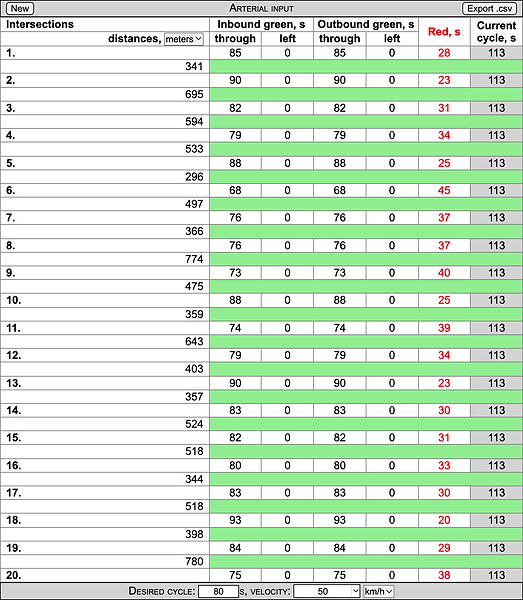
*Zhang L. et al (2016) "Signal coordination models for long arterials and grid networks"
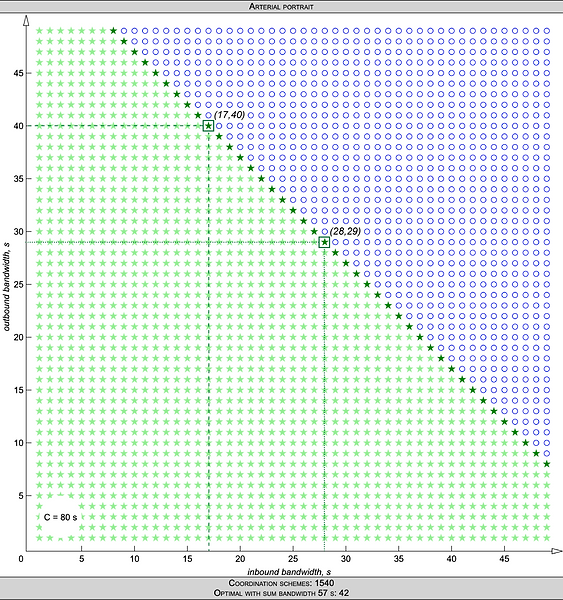
For the given arterial with the cycle length of 80 s Green Traffic Software provides 42 bandwidth pairs with maximal sum bandwidth of 57 s.
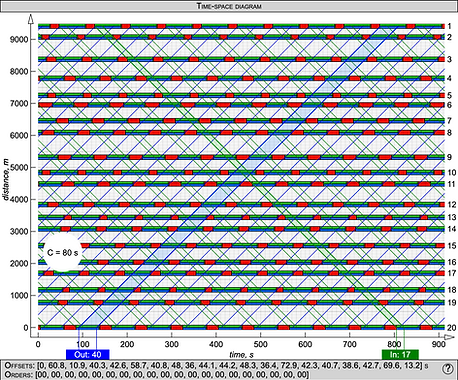
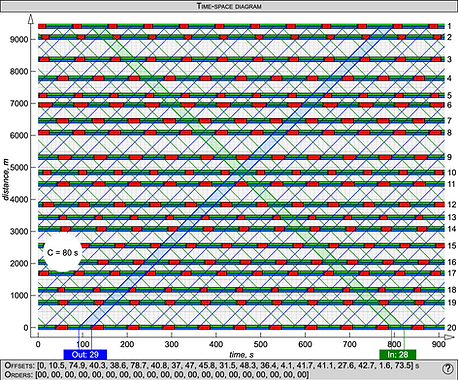
Time-space diagrams for two of them are shown below.
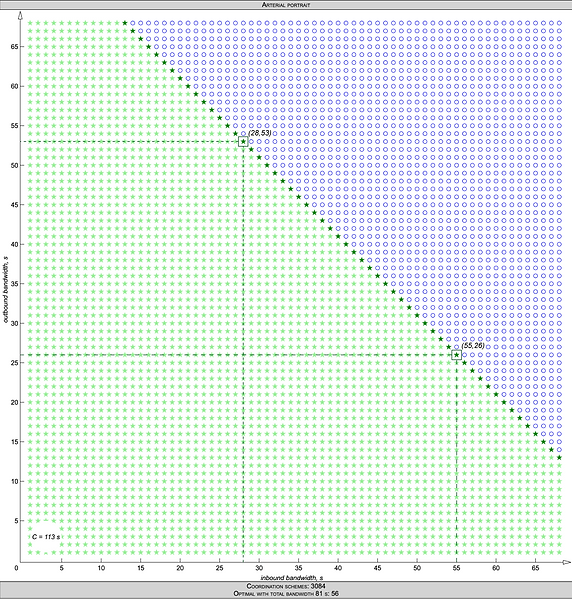
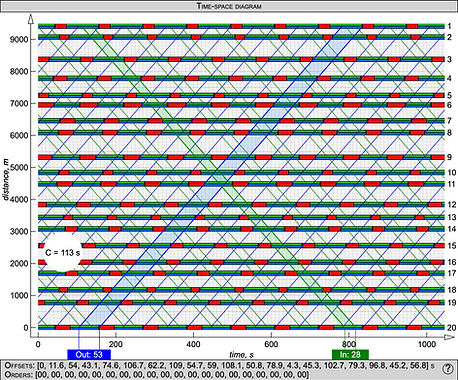
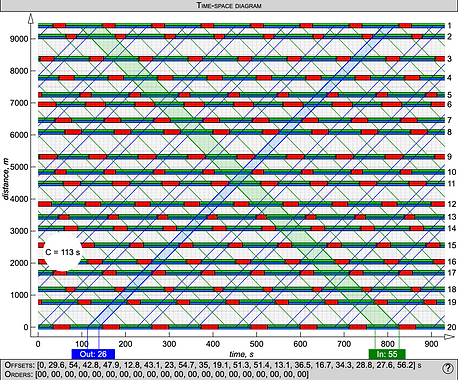
If the cycle length is changed to 113 s, Green Traffic Software provides 56 bandwidth pairs with maximal total bandwidth of 81 s.
Time-space diagrams for two of them are presented below.